Angular Example


Project Setup
For installation, configuration, and first-time setup, see the Angular Tutorial.
Overview
This example demonstrates how to integrate ApiSorcery with Angular projects. Angular is a comprehensive platform for building web applications with TypeScript, providing powerful features like dependency injection, RxJS observables, and a robust CLI.
Features
- Type safety: Full TypeScript support with generated interfaces and types
- RxJS integration: Seamless integration with Angular's reactive programming patterns
- Dependency injection: Angular services for clean architecture
- Axios integration: Built-in support for Axios HTTP client with interceptors
- IntelliSense support: Full IDE support with auto-completion and type checking
- Tree shaking: Optimized bundle size with ES modules support
Demo Functionality
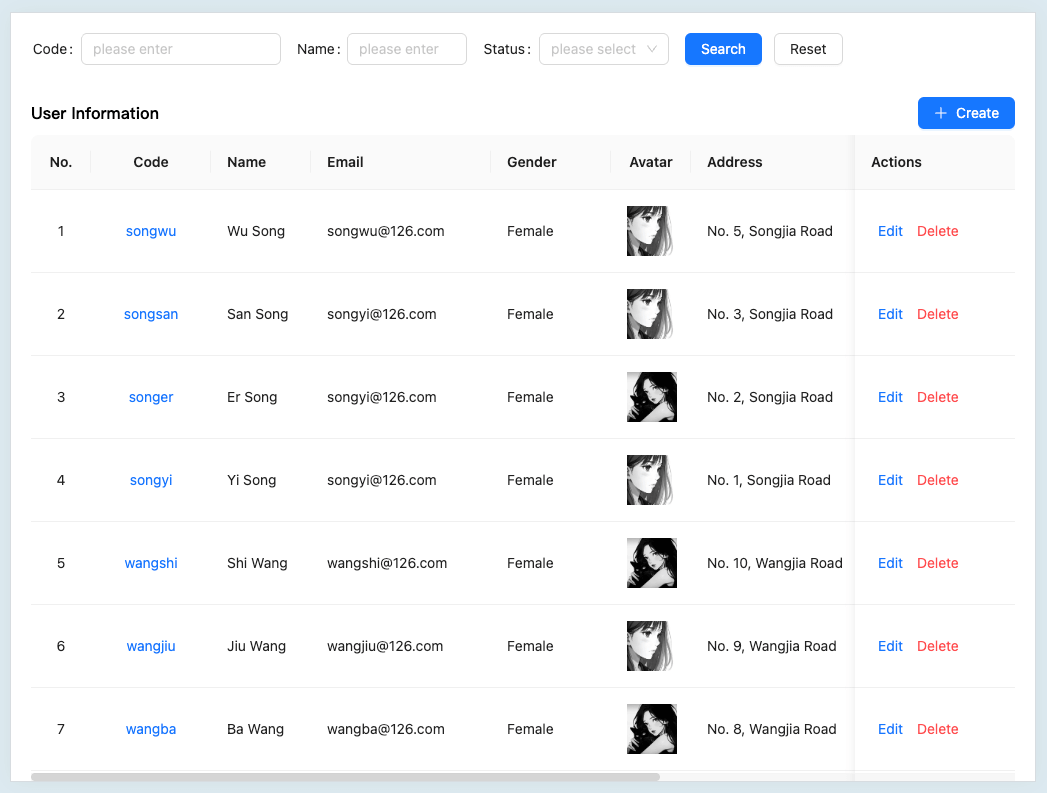
This demo app implements a complete User Management module backed by a live API:
- Paginated list — query users with filtering by code, name, and status
- Full CRUD — create, view, edit, and delete user records
- Avatar upload — upload images via
POST /file/upload, with 10 MB size validation - Excel export — download filtered results as
.xlsxvia the Blob response - Field validation — async uniqueness check for the
codefield before form submission
Code Examples
Paginated List
typescript
import * as ApiUser from '@/app/api/auto/demo/ApiUser';
import type { UserInfoDto } from '@/app/api/auto/demo/model';

async function getUsers(page = 1, filters?: { code?: string; name?: string }) {
  const res = await ApiUser.getUserPaged({
    pagination: { page, limit: 10 },
    code: filters?.code || '',
    name: filters?.name || '',
  });
  return { users: res.results as UserInfoDto[], total: res.total || 0 };
}
Excel Export
typescript
import * as ApiUser from '@/app/api/auto/demo/ApiUser';

async function exportUsers(filters?: { code?: string; name?: string }) {
  const res = await ApiUser.exportUsers({
    code: filters?.code || '',
    name: filters?.name || '',
  });
  const url = URL.createObjectURL(res.data);
  const link = document.createElement('a');
  link.href = url;
  link.download = res.name || 'users.xlsx';
  link.click();
  URL.revokeObjectURL(url);
}
Avatar Upload
typescript
import * as ApiFile from '@/app/api/auto/demo/ApiFile';

async function uploadAvatar(file: File): Promise<string> {
  const sizeMB = file.size / 1024 / 1024;
  if (sizeMB > 10) throw new Error(`File size (${sizeMB.toFixed(2)} MB) exceeds the 10 MB limit`);
  const fileId = await ApiFile.uploadFile({ file });
  return `${environment.apiUrl}/file/${fileId}`;
}
Best Practices
- Type Definitions: Leverage generated TypeScript interfaces for better type safety
- Angular Services: Encapsulate API calls in injectable services for reusability
- RxJS Operators: Use RxJS operators for data transformation and error handling
- Dependency Injection: Utilize Angular's DI system for clean architecture
- Unsubscribe Pattern: Always unsubscribe from observables to prevent memory leaks
- Error Handling: Implement proper error handling with Angular's error interceptors
- Environment Configuration: Use Angular environment files for different API endpoints
- Lazy Loading: Implement lazy loading for modules to optimize bundle size